
China Top Longest Range Walkie Talkie Manufacturers
Choosing a Longest Range Walkie Talkie begins with a reality check: advertised distance is not a field guarantee. Hills, concrete walls, antenna position, interference, and battery condition can all change what users hear. In a warehouse, a signal may cross several aisles; outdoors, a ridge can block it in seconds. Range is a system result.
Grand View Research estimated the global two-way radio market at about USD 9.6 billion in 2023 and forecast a 7.2% compound annual growth rate through 2030. These are market estimates, not proof that any model reaches a particular distance. Scope and methods differ between reports. Theodore S. Rappaport, a wireless-communications researcher and author, offers a useful technical lens: wireless performance depends on the channel between antennas. That is a paraphrase of his work, not a direct quotation.
This guide compares China’s leading walkie-talkie manufacturers through practical criteria: radio design, antenna options, battery endurance, durability, documented testing, and support for international buyers. A long-range claim deserves scrutiny. Ask how the range was measured, what terrain was used, and whether the result came from a controlled test or everyday operation. Small details matter: a radio clipped beneath a coat may perform differently from one held upright in open ground. Manufacturer specifications help, but they are only part of the decision. Some comparisons remain imperfect, because test conditions are not always disclosed. That uncertainty should be stated, not hidden.
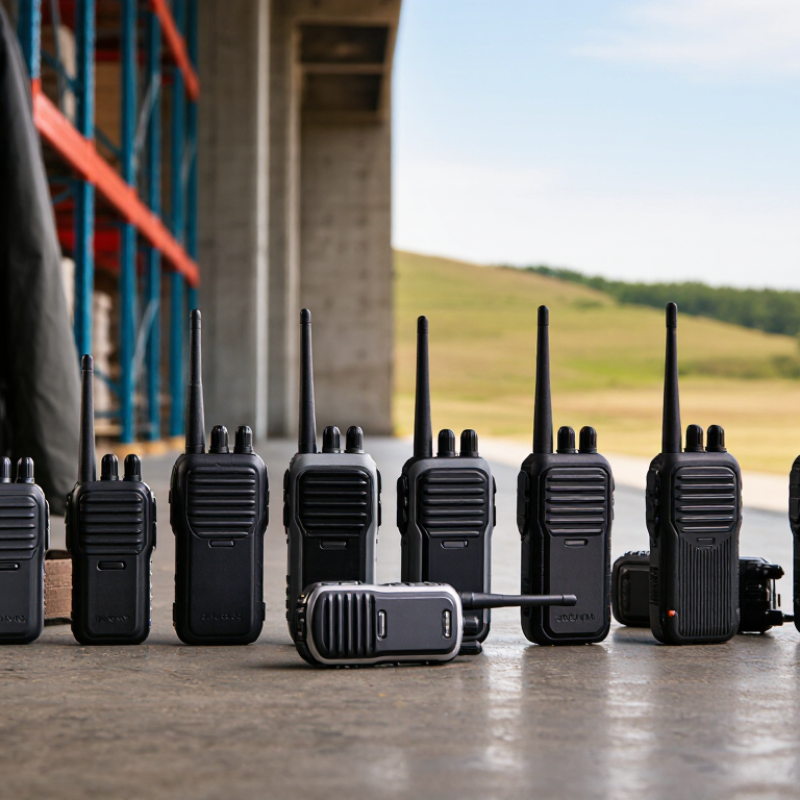
What Defines a Long-Range Walkie-Talkie?
A long-range walkie-talkie is defined by how reliably it communicates across distance, not by a single impressive number on its packaging. Published range figures often describe open, unobstructed conditions. Real use is less predictable. Hills, buildings, trees, antenna placement, and receiver sensitivity can all change the result.
In open terrain, two radios held above waist height may communicate farther than the same units used between concrete buildings. A ridge can block the signal, while a street corner may create a useful path around an obstacle. Dense foliage and metal structures can weaken reception. Small details matter. Even the user’s position can affect a weak signal.
When evaluating range, consider both the radio’s technical specifications and the environment where it will be used. Check whether tests were conducted in open terrain or among buildings, and treat maximum-distance claims as reference points rather than guarantees. Battery condition and antenna integrity also matter during extended use. A practical field test gives a clearer picture, though one test cannot represent every route or season. Range is partly a product feature, and partly a property of the landscape.
What Defines a Long-Range Walkie-Talkie?
Estimated radio horizon by antenna height
Estimates use the standard radio-horizon approximation, 4.12 × (√h₁ + √h₂) km, with antenna heights in meters and typical atmospheric refraction. These are theoretical line-of-sight horizons, not guaranteed communication ranges; terrain, buildings, foliage, antenna design, and radio conditions can substantially reduce actual range.
How Radio Technology and Operating Conditions Affect Range
China Top Longest Range Walkie Talkie Manufacturers
Walkie-talkie range depends on more than the distance printed in a product description. Radio frequency, transmitter power, antenna design, and receiver sensitivity all affect how clearly a signal travels. Digital radios may handle weak signals differently from analog models, but neither can overcome every obstacle. In open terrain, two radios with a clear line of sight may communicate across several miles. Buildings, hills, and dense trees can reduce that distance sharply. Small details matter.
Operating conditions can change from one shift to the next. A radio that works well across a clear field may struggle inside a concrete warehouse or between steep streets. The user’s position, antenna orientation, battery condition, and nearby electrical equipment can also affect reception. Advertised range usually reflects favorable test conditions, not a guaranteed result at a busy worksite. Even a careful estimate can miss something. Treat range claims as a starting point, then test radios in the places where people will actually use them.
Tips: Keep the antenna upright and use a fully charged battery. Test from several locations, including behind walls and around corners. Note where speech becomes unclear, and leave a practical margin for changing conditions.
| Technology or Operating Condition | Typical Characteristics | Illustrative Handheld Range | Effect on Communication Range |
|---|---|---|---|
| Clear line of sight | Two handheld radios with unobstructed paths, antennas held upright, and little nearby interference. | Several kilometres may be possible; greater distances can occur when both radios are elevated. | Usually the most favourable condition. The radio horizon and antenna height often matter more than advertised maximum range. |
| Dense urban area | Buildings, indoor walls, vehicles, and other structures obstruct or reflect radio signals. | Often hundreds of metres to a few kilometres, depending on building layout and indoor use. | Concrete, metal, and below-ground locations can cause substantial signal loss. Reflections may also create local dead spots. |
| Open, flat terrain | Few obstacles between radios, such as on open farmland or a broad, unobstructed field. | Several kilometres may be achievable with suitable radios and a clear path. | Low obstacles, ground curvature, vegetation, and antenna height still limit practical range. |
| Hilly or mountainous terrain | Ridges, slopes, and valleys interrupt or shield the signal path. | Highly variable: a short distance may fail across a ridge, while elevated radios with a clear path may communicate over much longer distances. | Terrain profile and line of sight dominate. A repeater positioned at elevation can extend coverage where permitted. |
| VHF handheld radio | VHF systems are commonly used outdoors and may perform well over open areas with a suitable antenna. | No fixed range; performance depends on antenna, terrain, frequency allocation, and lawful operating power. | Vegetation and terrain can affect coverage. Frequency use and power limits vary by country and radio service. |
| UHF handheld radio | UHF is widely used for business and personal handheld communication, including many built-up environments. | No fixed range; building materials, indoor location, antenna design, and local rules are important factors. | Signals can penetrate some building layouts effectively, but dense construction and metal structures may sharply reduce coverage. |
| Higher antenna position | The radio antenna is held clear of the body or mounted higher, with no obstruction immediately around it. | Can improve usable distance when raising the antenna clears nearby obstacles or expands line of sight. | Antenna height and placement can provide a greater benefit than a small increase in transmit power. |
| Repeater-assisted operation | A fixed relay receives and retransmits compatible radio signals, typically from a well-positioned site. | Coverage can extend well beyond direct radio-to-radio handheld range; the footprint depends on the site and system design. | Requires compatible equipment, access to the repeater, and compliance with applicable licensing and frequency rules. |
| Note: Range figures are qualitative planning guidance, not guaranteed test results. Actual performance varies with radio configuration, antenna, terrain, interference, weather, battery condition, and local regulations. Check the applicable rules for the country and radio service before transmitting. | |||
China’s Long-Range Walkie-Talkie Manufacturing Landscape
China’s long-range walkie-talkie manufacturing landscape combines radio-frequency engineering with dense component and assembly networks. The MarketsandMarkets Two-Way Radio Market report estimated the global market at USD 9.2 billion in 2023 and projected USD 11.8 billion by 2028. That demand supports manufacturers producing radios, antennas, chargers, and accessories for professional users.
Scale matters. So does consistent quality.
A “long-range” claim needs careful reading. In open terrain, a raised antenna may extend communication; warehouses, hills, and concrete walls can quickly reduce it. Power output alone is not the answer. Buyers should ask for range-test conditions, battery endurance, audio clarity, and performance after drops or rain exposure.
A test across a quiet field tells little about a crowded worksite. That distinction is easy to overlook. China-based suppliers often offer flexible configurations and substantial production capacity, but specification sheets do not replace independent testing.
I would still verify the exact model and test setup before comparing quoted ranges.
Key Features for Comparing Chinese Manufacturers
Range claims deserve careful reading when comparing Chinese walkie-talkie manufacturers. A stated maximum often reflects open terrain, clear line of sight, and ideal antenna placement. Numbers need context. Ask how range was tested, what equipment was used, and whether results came from repeatable trials.
A warehouse aisle, concrete walls, and nearby machinery can change performance sharply. Test them outdoors and indoors.
Compare receiver sensitivity, audio clarity, battery endurance, and channel stability alongside advertised distance. Request sample units and run the same route with each; note dead spots, speech dropouts, and battery level after a full shift. Check whether production samples match the tested units, and ask for documented quality-control procedures.
Review applicable radio requirements for your destination market, plus warranty terms and access to technical support. A neat comparison table can still hide differences in testing conditions.
No scorecard is perfect. I would revise the ratings after field trials, especially when buildings or terrain differ from the supplier’s test site.
How to Choose a Manufacturer for Your Communication Needs
Choosing a China-based long-range walkie-talkie manufacturer starts with your actual working environment. A claimed distance on a product sheet may assume open ground, clear weather, and few obstacles. Range is variable. Ask how the manufacturer measured it, and request test conditions, not just a headline figure. A warehouse with metal shelving needs different performance from a construction site with hills and scattered buildings.
Discuss the details your team will use every day. Ask about battery runtime during frequent transmissions, charging time, audio clarity in noisy areas, and compatibility with your existing equipment. Request a sample unit and test it across your real routes, including stairwells, loading bays, or outdoor work areas. Ask whether the manufacturer can adjust features such as channel settings or accessories to suit your needs. Check its quality-control process, repair support, replacement-part availability, and documentation for the markets where you operate.
A responsive sales contact is useful, but technical answers matter more. Ask for written specifications and clear warranty terms before placing a large order. Even a careful checklist can miss something; a short trial may reveal awkward controls or a battery that fades before a shift ends. Manufacturers that explain limitations honestly are often easier to evaluate than those promising exceptional range without evidence.