
China Best Self Adhesive Bandage Manufacturers for Wholesale Buyers
Wholesale buyers need more than a low unit price when choosing a Self Adhesive Bandage manufacturer in China. Consistent stretch, dependable adhesion, clean edges, and secure packaging all affect how a product performs after it reaches a clinic, pharmacy, or distributor. A roll that looks fine in a sample can still disappoint when cartons arrive with uneven widths or inconsistent tack. Small details matter.
Florence Nightingale, a respected nursing and hospital-care authority, wrote, “The very first requirement in a hospital is that it should do the sick no harm.” Her principle is not a bandage specification, but it offers a useful lens for evaluating wound-care supplies. Buyers should review material composition, product samples, quality-control records, packaging options, and communication before placing bulk orders. Ask clear questions. Request evidence. Compare answers, not just prices.
This guide examines China’s leading Self Adhesive Bandage manufacturers for wholesale buyers, with attention to product range, customization, production capability, and export experience. Supplier claims still need checking. A polished catalog is not proof of steady batch quality, and a fast reply does not guarantee reliable delivery. That is worth remembering. The comparison can help narrow the field, but each buyer should confirm requirements against intended use and local product standards. No supplier is perfect; even a careful checklist can miss something.
What Self-Adhesive Bandages Are and How They Work
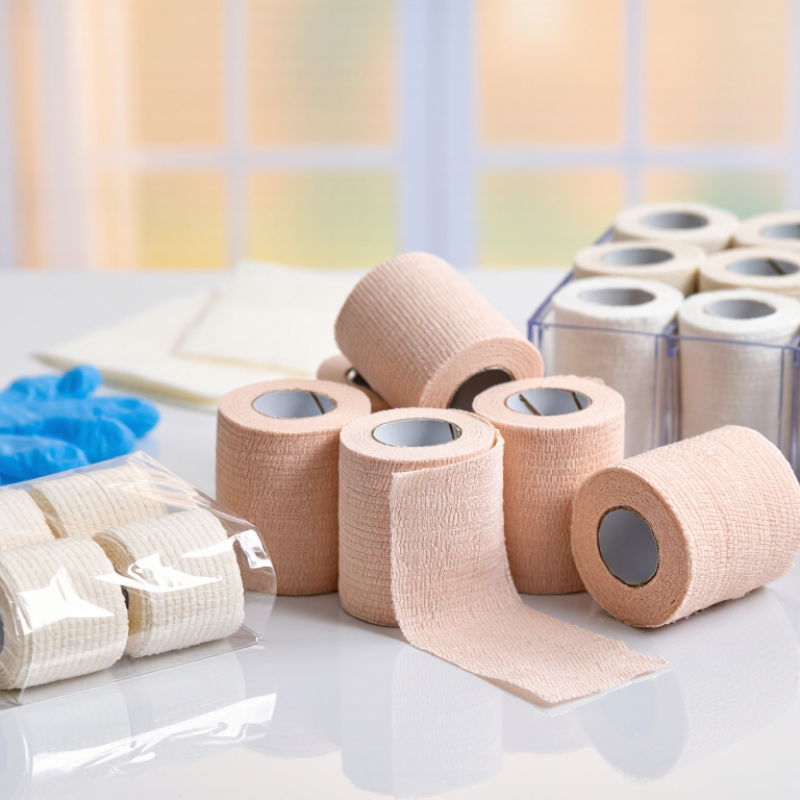
Self-adhesive bandages are flexible wraps that cling to themselves rather than sticking directly to skin. They are often made from elastic, nonwoven fabric with a cohesive coating. This lets the wrap stay in place without metal clips or separate tape. It can cover a dressing, secure a cold pack, or provide light compression around a joint. The fabric stretches as it is applied, then holds its position when pressed against itself. No glue on skin. That distinction is easy to overlook when comparing products for wholesale purchase.
A good fit depends on the intended use, the wearer, and the application area. A narrow roll may suit fingers, while a wider wrap can cover a knee or forearm more evenly. Apply it smoothly, with gentle overlap and even tension. Too much pull can restrict circulation or cause discomfort, especially around a limb. In practice, tension is rarely perfectly uniform; check the area after wrapping. Watch for numbness, tingling, unusual color changes, or increasing pain, and loosen the wrap if these occur. Self-adhesive wraps are not a substitute for clinical assessment when an injury is serious.
Tips: Check roll width, stretch, length, and package instructions before ordering. Test how easily the wrap tears by hand and whether it stays secure during movement. Ask suppliers for material and latex information when users may have sensitivities. Bulk pricing matters, but consistent quality matters more.
Common Materials, Sizes, and Product Types
Wholesale buyers should compare self-adhesive bandages by material, stretch, and how securely they cling to themselves. Many cohesive wraps use a nonwoven or cotton-blend fabric with elastic yarn and a cohesive coating. They stay in place without clips, but usually do not stick directly to skin. Some versions contain natural rubber latex; latex-free options are available. Check the product specification.
Common widths include 1, 2, 3, and 4 inches, while rolls often measure about 5 yards when stretched. Narrow wraps suit fingers and wrists; wider rolls cover larger areas with fewer turns. Actual stretch and finished length can vary by manufacturer, so compare samples before placing a large order. A neat label matters, too.
Product types range from lightweight cohesive wraps to firmer, higher-compression styles and softer, low-compression options. Buyers may also find perforated or breathable fabrics, plus individually wrapped rolls for cleaner storage and easier distribution. Ask suppliers for details on material composition, tensile stretch, roll dimensions, and packaging. A wrap that feels secure on a sample may behave differently after repeated movement, so testing it in realistic handling conditions is worthwhile. One detail is easy to miss. Overly tight wrapping can be uncomfortable, so product instructions should clearly explain suitable application.
How to Assess Chinese Manufacturers and Production Capabilities
When assessing Chinese self-adhesive bandage manufacturers, look beyond catalog photos. Request a live or recorded line tour, then check coating consistency, slitting accuracy, packaging controls, and batch records. Ask how they test peel adhesion, tensile strength, and performance after storage. The Grand View Research medical tapes market report projects 4.8% annual growth from 2024 to 2030, signaling demand for dependable output, not just low prices. A growth forecast does not prove any supplier’s capacity.
Tips: Ask for recent test reports and a sample from a normal production run. Compare the sample’s stretch, edge finish, and adhesion across several rolls. Confirm monthly capacity, lead times, and how rejected lots are handled. ISO 13485 certification can support confidence in a quality system, but it does not replace product-specific checks. Ask to see the certificate’s scope and current status.
For wholesale orders, review production records and traceability from incoming fabric to finished cartons. Verify that the manufacturer can explain material sourcing, inspection frequency, and corrective actions with clear examples. If possible, arrange an independent audit. A polished factory tour is useful, but it can miss weak spots; I would still verify the paperwork and retest samples before scaling an order.
Quality Standards, Certifications, and Wholesale Specifications
Wholesale buyers should assess more than price and roll length. The WHO’s 2016 Global Guidelines for the Prevention of Surgical Site Infection reported a pooled infection incidence of 11.8 per 100 surgical patients in low- and middle-income countries. This figure does not measure bandage performance, but it underlines why reliable, clearly documented wound-care supplies matter. Ask manufacturers for an ISO 13485 certificate and verify that its scope covers the relevant production site and product activities. For skin-contact materials, request a risk-based biological evaluation aligned with ISO 10993-1. Details matter.
Specify backing material, width, length, stretch recovery, adhesive type, and packaging format in the purchase agreement. Request batch-level inspection records for dimensions, adhesion, tensile performance, and visual defects. Ask for evidence. Review shelf-life data and storage conditions, and confirm whether the product is supplied sterile or non-sterile; do not treat these as interchangeable options. A sample roll should be checked on skin and under realistic handling conditions, not just on a clean tabletop. One weakness in many sourcing checklists is vague wording such as “strong adhesion.” Define acceptance criteria with the supplier, then retain agreed samples for comparison. No single certificate replaces product-specific test results or consistent lot traceability.
China Best Self Adhesive Bandage Manufacturers for Wholesale Buyers — Quality Standards, Certifications, and Wholesale Specifications
Common nominal roll widths include 2.5, 5, 7.5, and 10 cm. These are typical size options, not a universal specification; roll length, material, and performance can vary by product. Wholesale buyers should confirm product specifications and request applicable test reports and compliance documents from the supplier.
How to Compare Suppliers, Pricing, and Order Terms
When comparing self adhesive bandage suppliers, request a sample and a current specification sheet. Check width, relaxed length, stretch, roll weight, and packaging. Ask whether the stated length is measured before or after stretching. Small details matter. Test whether the bandage holds to itself without excessive pressure, fraying, or difficult unwinding. Compare several rolls, not just one. A single sample can hide variation between production batches. Ask for lot identification and written quality checks, then confirm that the sample matches the product offered for wholesale.
A low unit price may exclude carton costs, freight, or custom packaging. Request a written quotation showing the minimum order quantity, price breaks, sample charges, and quote validity period. Ask for the production lead time and whether it starts after payment, artwork approval, or deposit. Get the payment schedule and inspection arrangements in writing. Ask how shortages, damaged cartons, or specification differences are handled. Ask for evidence. If a supplier promises unusually fast delivery or a dramatic discount, verify the details before placing a large order. I would not compare suppliers using price alone; packaging and consistent stretch matter too, though buyers sometimes overlook both.